I’ve published over 200 romance novels. Some of them took months to write. Some took weeks. The difference? Not talent or caffeine (though both help) — it was learning to use AI as a creative partner, not a replacement.
AI writing tools have exploded in the last two years, and the romance author community has opinions. Strong ones. Some authors swear by them. Others treat them like the literary antichrist. I’m somewhere in the middle — but firmly on the side of “these tools can make you a better, faster writer if you use them right.”
Here’s my honest take on the best AI writing tools for romance authors, what they’re actually good at, and where they’ll lead you astray.
What AI Writing Tools Can Actually Do for You
Let me be clear: AI is not going to write your novel for you. Not a good one, anyway. What AI excels at is the work around the writing — the parts that drain your creative energy before you even open your manuscript.
Brainstorming and ideation: Stuck on your next book concept? AI can generate dozens of “what if” scenarios in minutes. I use it to explore trope combinations, character backstory options, and plot complications I wouldn’t have considered on my own.
Outlining and structure: Feed an AI your genre, tropes, and heat level, and it can generate a structural outline that hits the right beats. It won’t be perfect — you’ll need to adjust for your voice and vision — but it gives you a starting framework instead of a blank page.
Blurb writing: This is where AI genuinely shines. Writing blurbs is a completely different skill than writing novels, and most authors struggle with it. AI can draft multiple blurb versions that you polish and personalize.
Research and world-building: Writing a historical romance set in Regency England? AI can help you generate period-accurate details, social customs, and vocabulary — saving hours of research rabbit holes.
The Tools Worth Trying
ChatGPT and Claude: The general-purpose AI assistants are surprisingly useful for romance authors. They understand genre conventions, can brainstorm in character voices, and are excellent at generating marketing copy. I use them daily for ideation and blurb drafts.
Sudowrite: Built specifically for fiction writers, Sudowrite understands narrative structure and can expand scenes, suggest descriptions, and help with dialogue. It’s more expensive than general AI but more tuned to creative writing.
ProWritingAid: Not generative AI, but its AI-powered editing catches pacing issues, repeated words, and readability problems that spellcheck misses. Essential for self-editing before your manuscript goes to a human editor.
Plottr and similar plotting tools: Some plotting software now integrates AI to help you build timelines, character arcs, and beat sheets. Useful if you’re a visual plotter.
Where AI Falls Short in Romance
Here’s the truth nobody marketing AI tools wants to say: AI cannot write emotional depth. It can mimic it. It can produce sentences that look like emotional beats. But the lived, specific, messy human emotions that make readers cry at 2 AM? That’s you. That’s always going to be you.
AI also struggles with voice consistency. If you have a distinctive narrative style — and as a romance author, you should — AI-generated prose will feel generic unless you heavily rewrite it. The “uncanny valley” of AI writing is real, and romance readers have excellent BS detectors.
Finally, AI doesn’t understand consent, power dynamics, or the nuanced boundaries that make romance (especially dark romance) feel safe for readers even when the content is edgy. Human judgment is non-negotiable here.
My Method: AI-Assisted, Human-Written
Here’s how I actually use AI in my process:
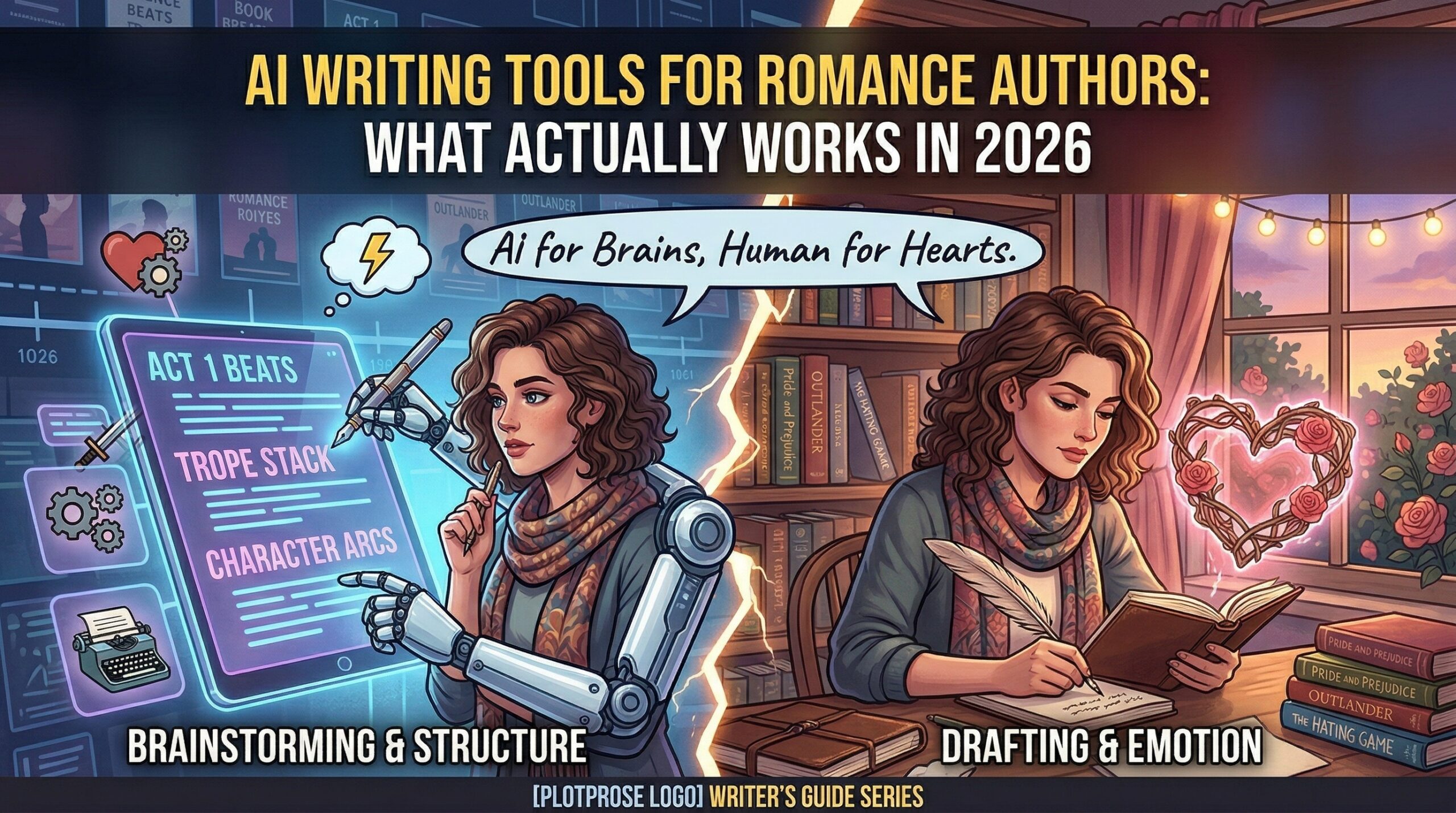
Phase 1 — Concept: I brainstorm with AI. I’ll describe the tropes I want, the emotional arc I’m aiming for, and the setting. AI generates possibilities. I pick what sparks something in me.
Phase 2 — Outline: I build a structural outline using my five-beat method, sometimes with AI’s help expanding scenes or suggesting complications. This is also where tools like PlotProse come in — pre-built outlines that give you professional structure without starting from scratch.
Phase 3 — Draft: I write the actual prose myself. Every word. This is where voice lives, and voice is what brings readers back. AI can’t replicate your voice — it can only dilute it.
Phase 4 — Edit: I use AI editing tools to catch technical issues, and I use generative AI to rewrite blurbs, taglines, and marketing copy. This is where AI saves me the most time.
The Ethics Question
I know this topic is loaded. I believe in transparency — readers deserve to know what they’re getting. My novels are written by me, with AI used as a brainstorming and editing tool. I don’t use AI to generate prose that goes into my books.
Every author needs to find their own line. But whatever you decide, be honest about it. The romance community values authenticity above almost everything else.
The authors who thrive in this new landscape won’t be the ones who let AI write for them — they’ll be the ones who use AI to write more of what only they can create.