
Your finished novel, scored, staged and turned into a 60-episode drama script.
Short-form vertical drama — the 60-90 second, cliffhanger-driven format — runs on a strict, honest bar: a two-lead story, a real power imbalance, and conflict a camera can see. The Micro Drama Studio scores your manuscript against that bar, helps you fix it if it falls short, and — once it clears the gate — converts it into a full 60-episode script, built in stages you sign off.
Output files only. Scripts, a bible and a production summary — PDF and Word files.
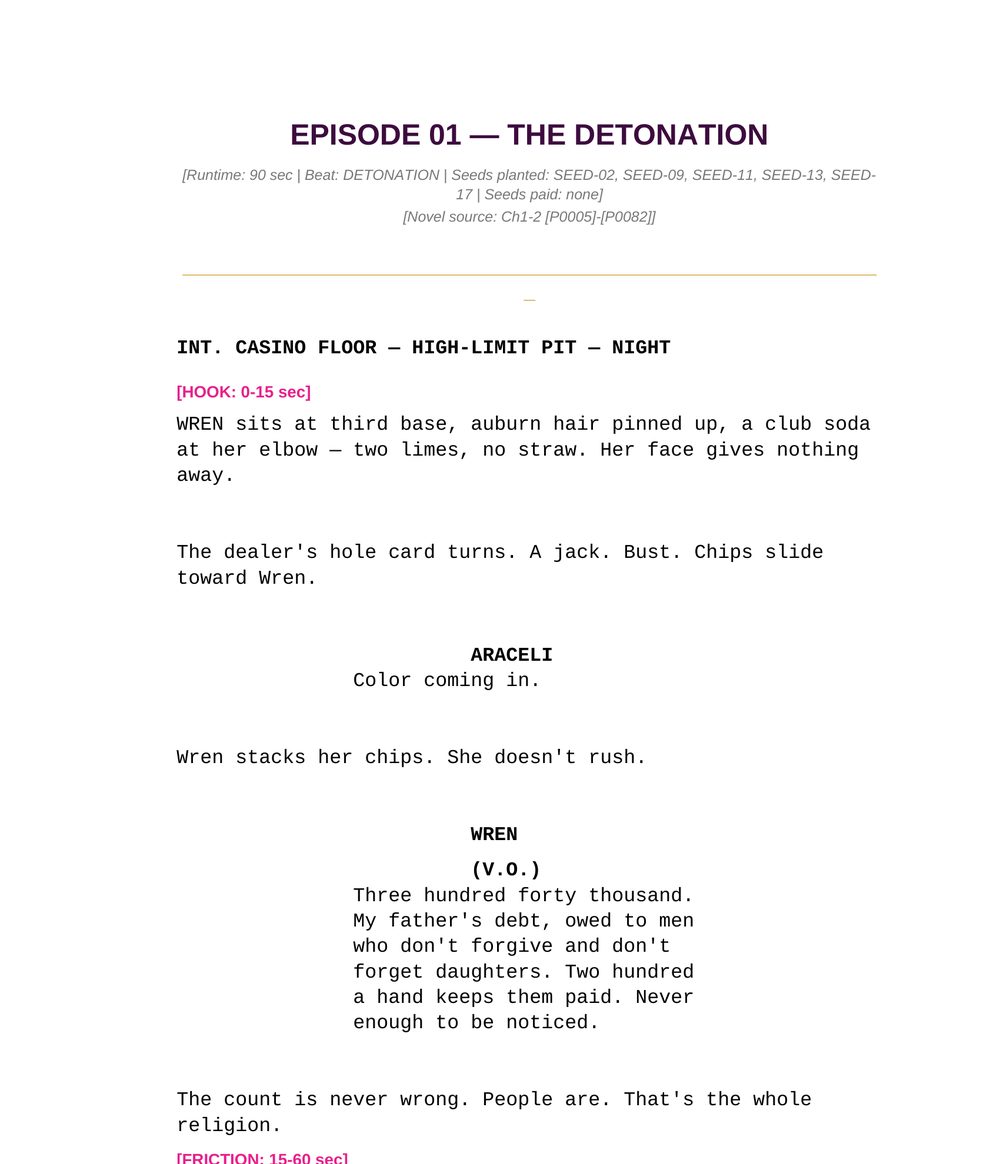
A real script page · The Marker, EP01 “The Detonation”

Built for a finished romance manuscript in English.
This is for you if
- You have a complete manuscript and want a clear, honest read on whether it can carry a 60-episode vertical drama script.
- Your story already leans on a real power gap between two leads, a hidden truth, and conflict that plays out in scenes, not summary.
- You want the script and packaging work done for you, then plan to take the finished files to your own video production route.
- You’re prepared to review and sign off six checkpoints along the way — this is a staged build, not a one-click export.
Probably not for you if
- You want us to shoot, animate or render the episodes — the Studio produces scripts and packaging files only, never video.
- Your book is outside our one lane: romance, written in English, closed-door / fade-to-black, under about 80,000 words. A thriller, a family drama, open-door heat, another language or a much longer manuscript isn’t a fit.
- Your manuscript is still in progress. We score a complete novel, not a synopsis or a partial draft.
- Your story is an ensemble piece, an epic-scale plot, or has no natural two-lead center — the format’s Production Simplicity and Episode Engine dimensions are built around two locked leads in a handful of interiors, and that’s hard to move without becoming a different book.
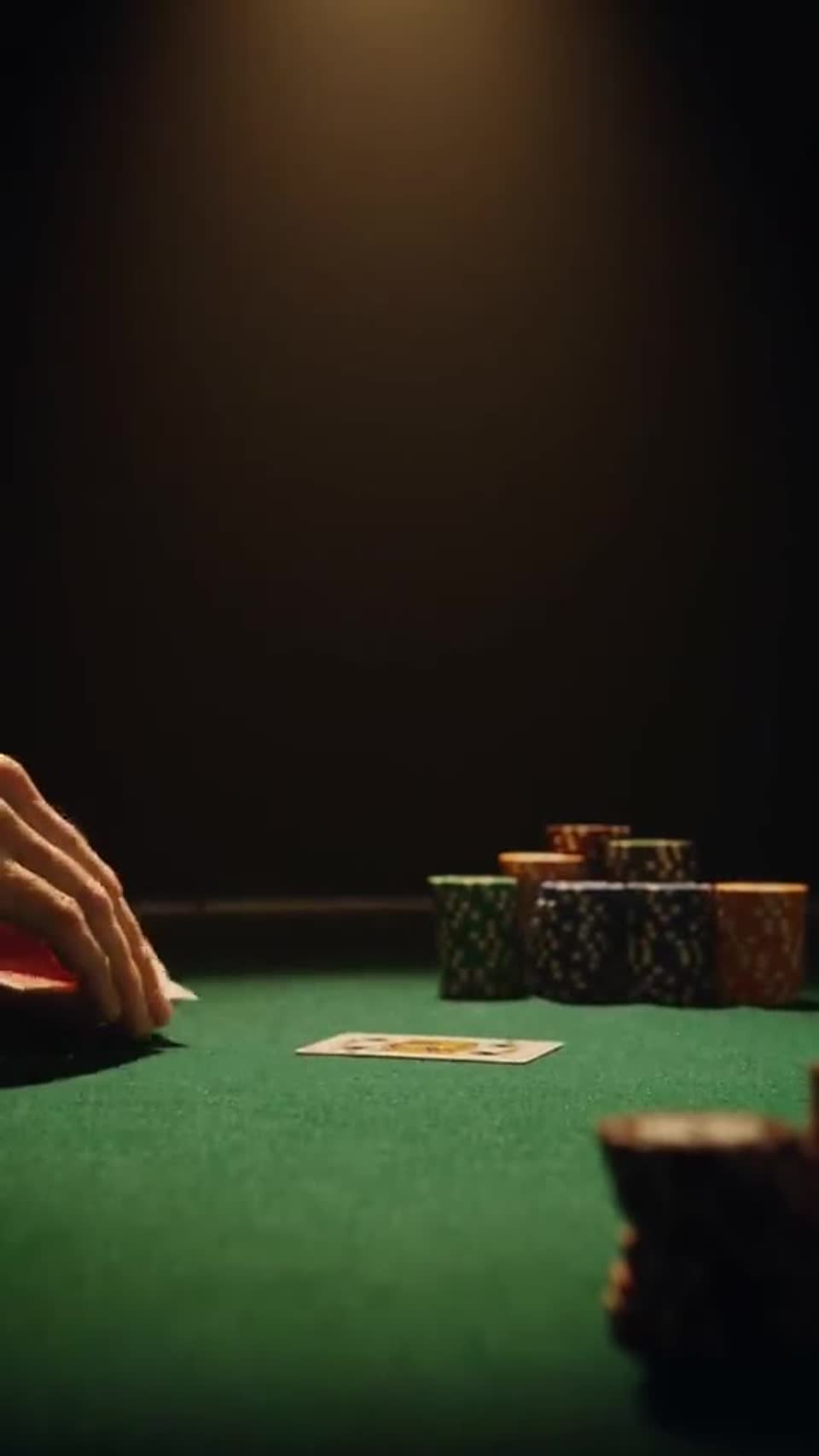
A card counter at her father’s casino table, counting his debt — the kind of scene the scoring bar is built to find.
Six dimensions, scored 1-5, on what’s actually on the page
Every manuscript is read in full and scored against six dimensions that decide whether a story survives the vertical-drama format — each score has to cite specific chapters, not a plot summary.
Visual Conflict
Is the tension something a camera can show — a confrontation, a look, a physical stake — or does it only live in a character’s head?
Trope Clarity
Is there one clear, nameable trope driving the story (from a standard list of ten), not a blur of two or three competing ones?
Power Imbalance
Is there a real, structural gap between the two leads — money, position, leverage — or are they simply equal partners?
Visible Emotional Stakes
Do the feelings play out in scenes the audience can watch happen, or only in narration telling us how a character feels?
Episode Engine
Does the plot naturally break into 60-90 second, cliffhanger-sized units, or does it resist being cut that small?
Production Simplicity
Can it be shot with two locked leads across three to five static interiors, or does it need a full ensemble or epic scale?
The verdict is a straight sum out of 30
| Your score | Verdict | What you can order |
|---|---|---|
| Under 22 | REBUILD | Rework Package only (no Full Script yet) |
| 22–25 | REWORK | Full Script, or Rework Package first |
| 26–30 | GREENLIGHT | Full Script |
Below 22, we won’t convert a book — we’ll show you what to fix first. 22–25 converts with notes on the dimension that needs the most work. 26 and above converts clean. The single lowest-scoring dimension is always named, whatever the total.
“A viability score built on a plot summary is worthless. Every scoring read is a full read of the manuscript, chapter by chapter.”
Micro Drama Studio · scoring methodScore it. Fix it if needed. Convert it.
Every book runs through the tiers in the same order the scoring gate requires.
Everyone starts with the free read (your first book’s Viability Report). The Rework Package and the Full Script unlock after it, depending on your score: the Full Script needs 22 or more, and the Rework Package is available for any score under 26.
Launch pricing
A full read of your manuscript, scored on all six dimensions with a straight GREENLIGHT / REWORK / REBUILD verdict.
- One branded PDF, 10–18 pages
- Cover, verdict summary, six dimension pages
- Rebuild recommendations for any 1–2 score
- Casting section if your score is 22 or higher
Launch pricing
The bridge for a manuscript that scored REWORK or REBUILD — a diagnosis and a concrete plan to lift it into convertible range, without a full rewrite.
- One branded PDF: Dimensional Diagnosis
- Chapter-by-chapter plan: KEEP / REVISE / CONSOLIDATE / CUT
- 3–5 sample rewrites in your own voice
- A re-check protocol back into the score
Launch pricing
The complete conversion: your novel built out into a 60-episode vertical drama script, built in stages you sign off, script and packaging only.
- 60 individually named episode .docx files
- One full-script master .docx
- A Season Bible and six Batch Review documents
- A Production Summary PDF
- A branded Pitch Package PDF — cover, concept, full character profiles, three-act outline and ten demo episode scripts, ready to hand to a buyer
- A Buyer Pack PDF — one file you can send to any platform or producer, with everything they ask for
There is no path to a Full Script without a passing score in hand — we won’t convert a book that scores under 22, we’ll show you what to fix first. A book that scores REBUILD isn’t a dead end: the Rework Package exists to get it to 22, or, honestly, sometimes the right answer is to adapt a different book instead.
Your first Viability Report is free; Rework and Full Script are paid per book, and nothing is charged until you approve a tier. Checkout and your files live on plotprose.com.
What a series costs
One read per book. The first book’s read is free; the rest are $1 each. Rework Package and Full Script are priced per book.
| Per step | 1 book | 3 books | 6 books |
|---|---|---|---|
| Viability Reportfirst book free, then $1 each | Free | $2 | $5 |
| Rework Package$5 per book | up to$5 | up to$15 | up to$30 |
| Full Script$50 per book | up to$50 | up to$150 | up to$300 |
The Rework Package is only for a book that scores under 26, and the Full Script needs a score of 22 or more, so “up to” is the most a series of that size can pay for that step. Nothing is charged until you approve a tier.
The Series Buyer Pack (one PDF across every finished book in your order) is among the files listed under “What you get” below.
From manuscript to files on your own outputs page
The same six steps for every book, in order — nothing skips ahead, and nothing is charged until you press a book’s own pay button.
Send your manuscript
Upload your finished novel — DOCX or EPUB — with your name and email. Nothing is charged yet.
Confirm your email
Click the link in our confirmation email. This is the double opt-in that also unlocks your one free first read.
Your free read lands
Your first Viability Report is free, scored on all six dimensions out of 30. We email you when it’s ready, usually within the hour.
Choose per book
Greenlight — Full Script $50 · Rework Package $5 · an extra read $1. The pay button on a book’s own card is the purchase for that book, and nothing runs until it’s paid.
Six checkpoints you approve
Viability, then Season Bible & Arc Map, then four episode batches. A later checkpoint never starts before the one before it is signed off.
Your files
Every deliverable lands on your outputs page as soon as it’s ready — download each file on its own, or everything at once as one zip.
What you get
What lands on your outputs page, checkpoint by checkpoint:
| Checkpoint | Files |
|---|---|
| Viability Report | Viability_Report.pdf |
| Rework Package (if you order it) | Rework_Package.pdf |
| Season Bible & Arc Map | SeasonBible.docx, ArcMap.docx |
| Batch 1 (episodes 1–10) | Batch1_Review.docx, EP01–EP10 episode .docx files |
| Batch 2 (episodes 11–20) | Batch2_Review.docx, EP11–EP20 episode .docx files |
| Batches 3–5 (episodes 21–50) | Batch3_Review.docx, Batch4_Review.docx, Batch5_Review.docx, EP21–EP50 episode .docx files |
| Batch 6 & final assembly (episodes 51–60) | Batch6_Review.docx, EP51–EP60 episode .docx files, ProductionSummary.pdf, <Title>_FULL_SEASON.docx (the full-script master document), <Title>_Pitch_Package.pdf, <Title>_Buyer_Pack.pdf |
| Every book in your order at Batch 6 & final assembly | <Series or Pen Name>_Series_Buyer_Pack.pdf — one Buyer Pack across every finished book |
Want to see it before you send anything? See a sample outputs page → Made-up books and files; nothing on it is live.
How it reaches you
- A confirmation email the moment you submit, sent by the Micro Drama Studio.
- After that, one combined email per moment something is ready — a report or checkpoint to approve, a book that needs your file, or a finished script — never several at once.
- Replies to the Studio’s own emails aren’t read; a real question reaches us at
info@plotprose.com. - Nothing is charged until you press a book’s own pay button.
- We email you when it’s ready, usually within the hour. Your own review time between checkpoints is usually the bigger share of the total time.
When something needs you
- Wrong or unreadable file — that book’s card shows a red “Needs your file” badge with a “Replace manuscript” control right there; your read starts again straight away, at no extra charge. We email you when it’s ready, usually within the hour.
- Under 22 — the book stays Rework-only: no Full Script until a Viability score clears 22, and the Rework Package stays available for anything under 26.
- Before you confirm your email — nothing runs at all, not even your free first read, until you click the confirmation link.
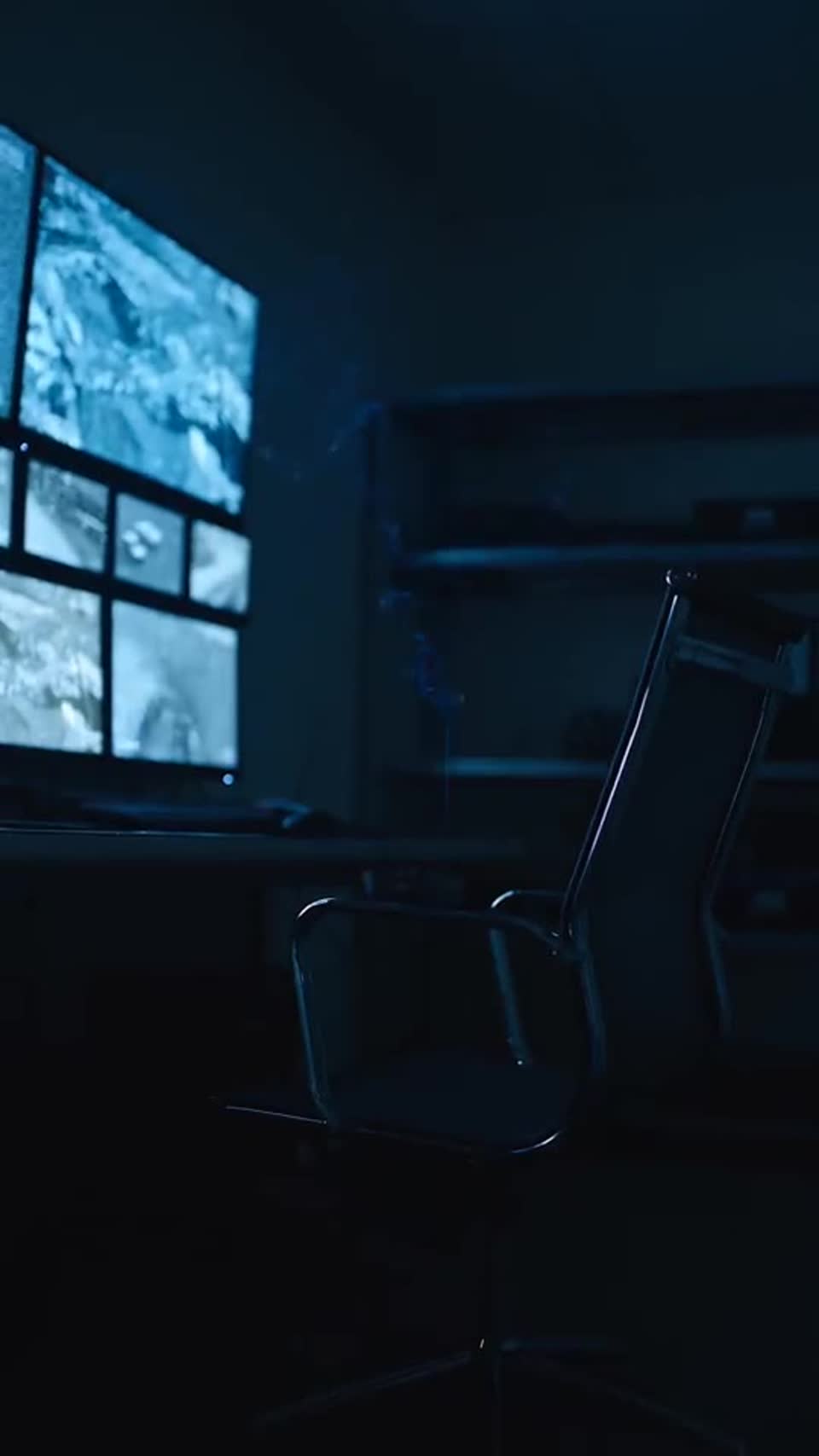
Every script starts the same way — two locked leads, a hidden truth, and someone watching.
Staged so drift is caught every 10 episodes, not discovered at episode 60
Six author checkpoints are mandatory. Batch two is not drafted until batch one is signed. Nothing auto-advances — the Season Bible, the Arc Map, and each of the six 10-episode batches all wait for your sign-off.
Season Bible
Two locked leads, a five-part reveal structure (a new truth surfaces at episodes 3, 8, 10, 30 and 50), 15–25 planted clues tracked through the script, three to five anchor locations, wardrobe continuity and tone rules.
Arc map
All 60 episodes mapped across six 10-episode batches — Pilot, Second Wave, Midseason, Escalation, Dark Night, Payoff.
Batch 1 — the Pilot
Ten episodes drafted with the beat structure locked (Detonation, Lock, First Crack, External Threat, Public Moment, Brick, First Reveal, Betrayal, Choice, Paywall), with an explicit “does the show work” check before anything else is drafted.
Batches 2–6
The remaining 50 episodes, drafted ten at a time, each batch with its own review document and checkpoint before the next batch begins.
The 8-second hook and the Episode 10 paywall
Every episode is built to win the first 8 seconds — the audience’s real decision window — and the script carries one fixed paywall, always at Episode 10.
Final assembly
All 60 episodes assembled into one full-script master document, plus a Production Summary covering shot counts, location reuse and screen-time split.
HOOK
The 8-second decision window has to be won here.
FRICTION
The conflict of the episode plays out.
TURN
The scene turns on new information or a reversal.
CLIFFHANGER
A hook image and a next-episode teaser tag close it out. Runtime is hard-capped at 90 seconds.
Three of our own books, scored the same way yours will be
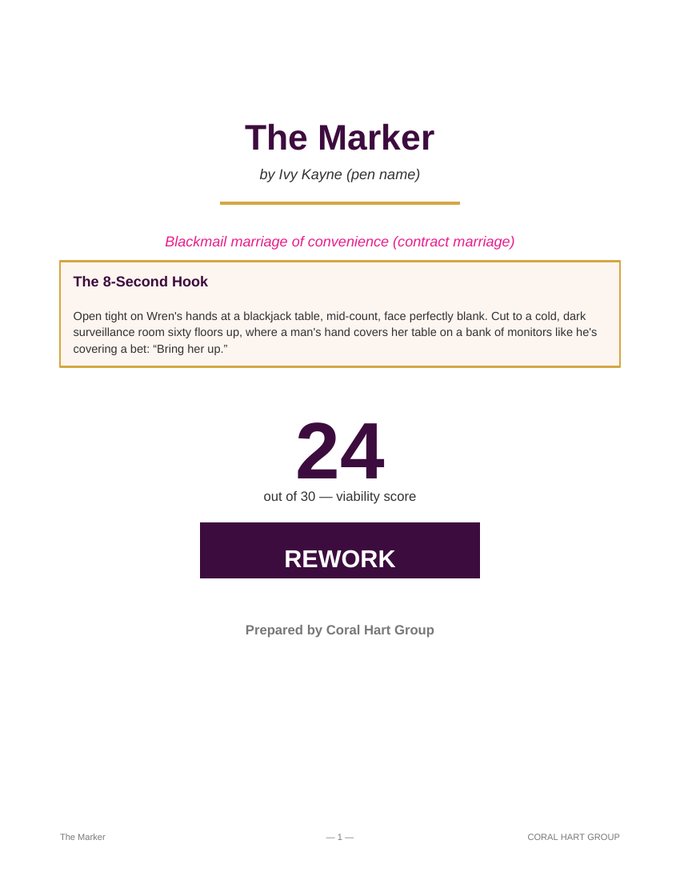
The Marker
A card counter marries the billionaire who caught her to save her family — not knowing he’s secretly watched her for months. Scored REWORK, and still became a complete 60-episode script, built in stages you sign off, with a full pitch package.
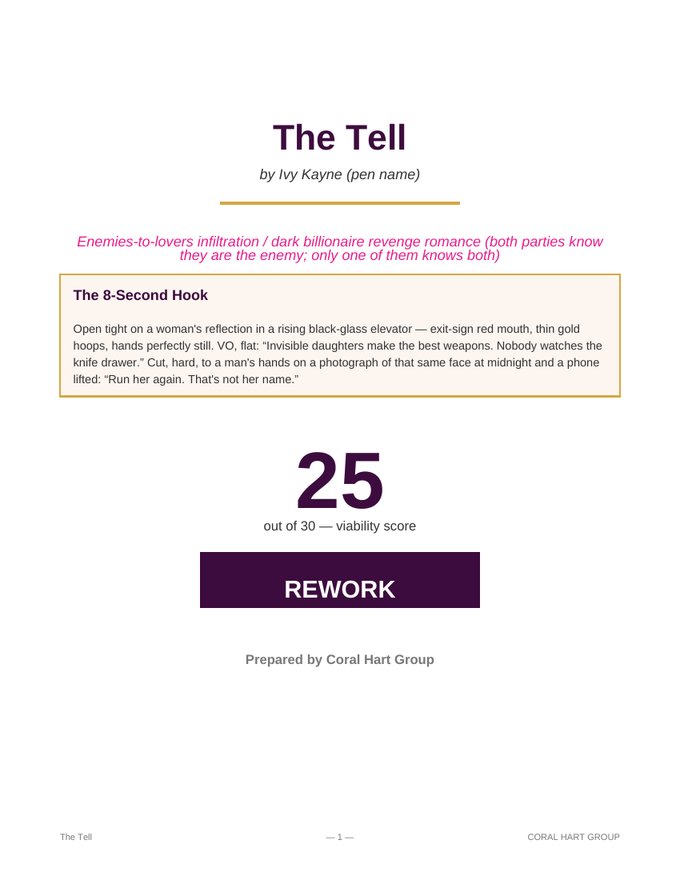
The Tell
Scored REWORK, and produced its own complete 60-episode script and pitch package.
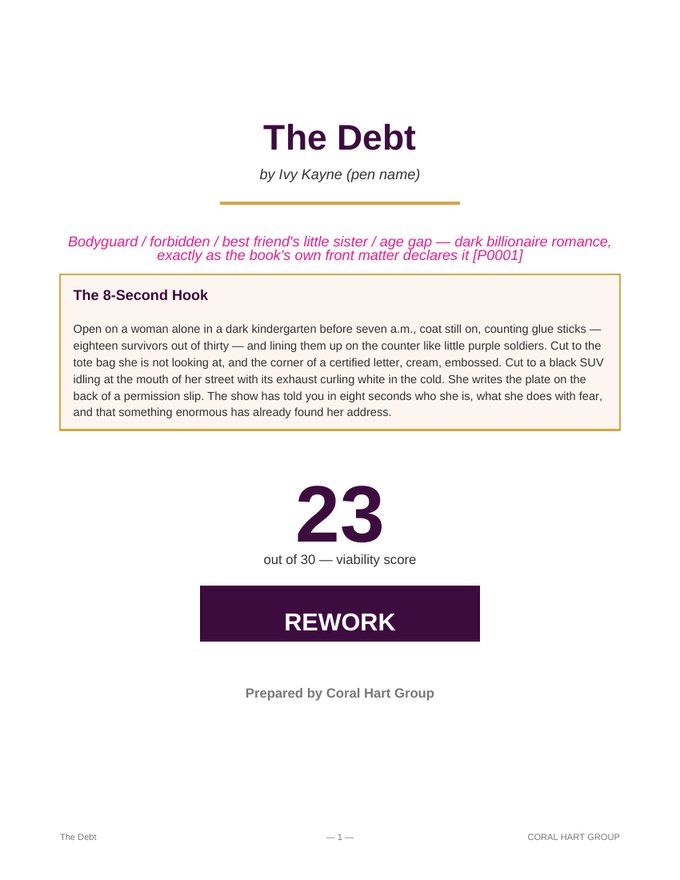
The Debt
A bodyguard/forbidden-romance with a stacked power imbalance and a staged hidden-truth ladder — the strongest bones of the three on story, held to REWORK by four production-heavy set pieces. Diagnosed with a Rework Package and converted into its own full script and pitch package.
All three are our own books, put through the same scoring gate every manuscript gets. All three have been through the Rework Package tier — The Marker’s is excerpted below.
Real sample output, from The Marker
Three excerpts, pulled straight from The Marker’s own build.
Rework Package · Dimensional Diagnosis
Production Simplicity — Current: 3/5 → Target: 5/5
Failure pattern: Location Sprawl + Cast Crowd (partial)
Diagnosis: Production Simplicity is the only dimension below 4 for The Marker, and it is a location/crowd problem, not an action-sequence problem — this book has no fights, chases or stunt work anywhere in it. The Marker’s actual cost is eleven-plus distinct interior locations, plus two genuine crowd set-pieces: the Commission hearing gallery, which ‘ran full past fire code,’ and the casino-floor ‘one hand’ showdown, staged in front of ‘ten thousand strangers.’
From The Marker’s Rework Package
Full Script · Episode 01, The Detonation
INT. CASINO FLOOR — HIGH-LIMIT PIT — NIGHT
WREN sits at third base, auburn hair pinned up, a club soda at her elbow — two limes, no straw. Her face gives nothing away.
The dealer’s hole card turns. A jack. Bust. Chips slide toward Wren.
ARACELI
Color coming in.
WREN
(V.O.)
Three hundred forty thousand. My father’s debt, owed to men who don’t forgive and don’t forget daughters. Two hundred a hand keeps them paid. Never enough to be noticed.
A man in a midnight-blue suit falls in at her shoulder — SILAS.
SILAS
Ms. Callahan.
WREN
I think you have me confused with someone.
SILAS
No, ma’am. Mr. Vane would like a word.
CUT TO: INT. THE SKY — CONTINUOUS
CASH stands over a bank of monitors, sleeves rolled, watching camera forty-one.
CASH
(into the line)
Silas. Bring her up.
He lays his hand flat on the console, over her table, like a man covering a bet.
CASH
And Silas — be polite. She’s going to be your boss.
CUT TO BLACK.
Episode 1 of The Marker, “The Detonation” — the opening and the close, with some lines trimmed to fit this card
Full Script · Pitch Package
The Marker, by Ivy Kayne (pen name) — Blackmail marriage of convenience (contract marriage)
The 8-Second Hook — Open tight on Wren’s hands at a blackjack table, mid-count, face perfectly blank. Cut to a cold, dark surveillance room sixty floors up, where a man’s hand covers her table on a bank of monitors like he’s covering a bet: “Bring her up.”
24 out of 30 — viability score — REWORK
Concept · The Pitch — A card counter marries the billionaire who caught her to save her family — not knowing he’s secretly watched her for five months already.
From The Marker’s Pitch Package
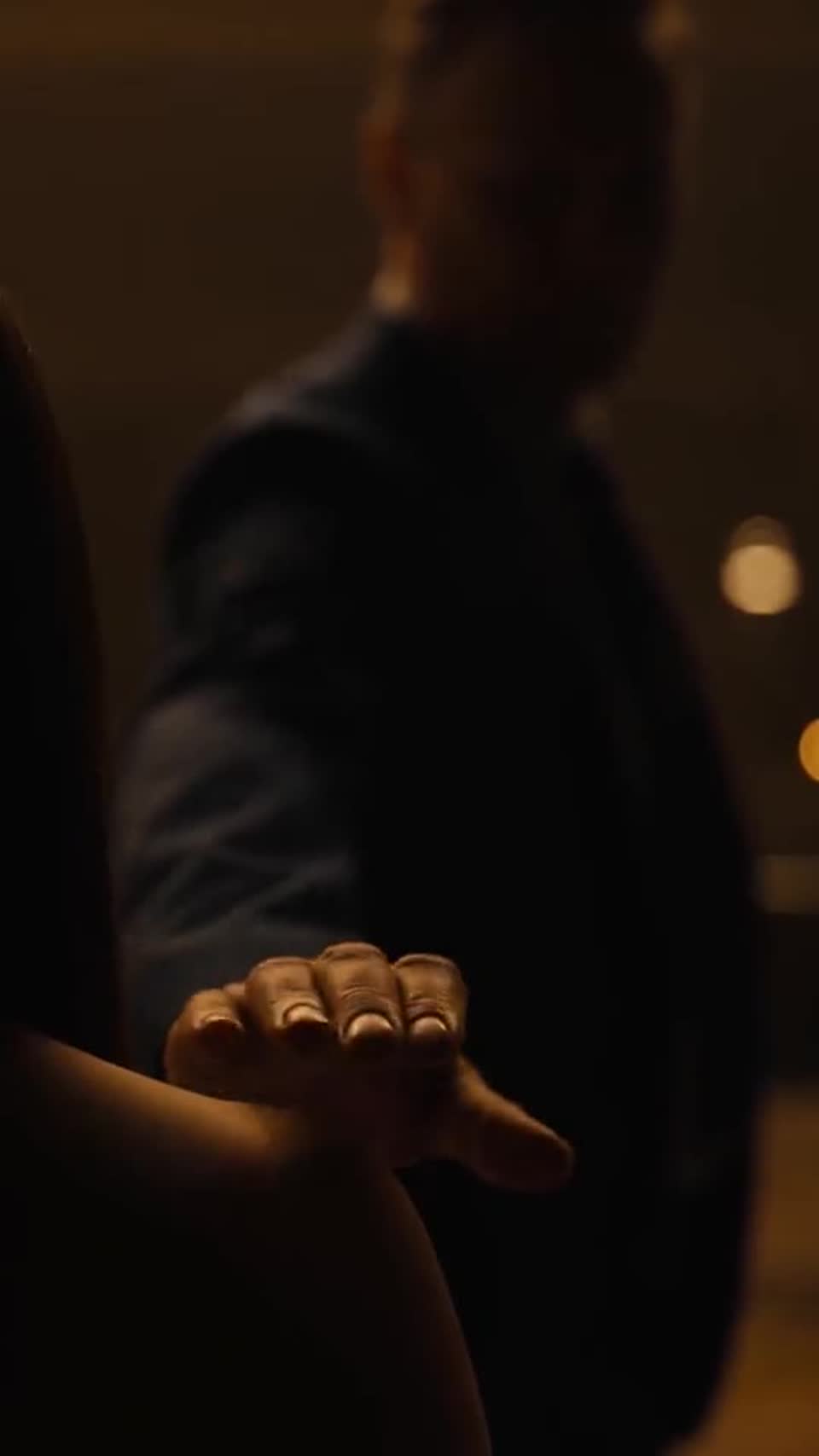
The turn, the reach, the cliffhanger — built the same way, episode after episode.
The questions every author asks first
Do you produce the video episodes?
What’s the difference between the three tiers, and how do I pay for them?
What if my book scores REBUILD?
Does this work for any genre?
What if my manuscript is very long?
Is this only available in English?
Do I have to approve each batch?
What do I actually receive?
What emails will I get?
How long does each step take?
I uploaded the wrong file.
What does “Needs your file” mean?
How do I pay, and for which book?
Where are my files?
What is in the Pitch Package?
Why won’t you convert a book that scores under 22?
Can I add a book later?
Who do I contact?
Send us your manuscript
One finished book, or a whole series. Tell us who you are, what you want scored or built, and upload each manuscript — DOCX or EPUB. Nothing is charged here, and nothing is written until you have signed off the checkpoint before it.
Thank you — your manuscript is in.
Our team will read it and be in touch. You can bookmark your own outputs page now — deliverables will appear on it as they land.
Check your inbox and confirm your email to start the read. We email you when it’s ready, usually within the hour.
Bring us your finished manuscript
We’ll score it against the six dimensions, tell you honestly where it stands, and walk you through what a Full Script build would look like for your book.
Send us your manuscript